
History
Texts edited by Francesco Bola (art historian) and Mattia Olivieri (historian)
Prehistory and Roman occupation
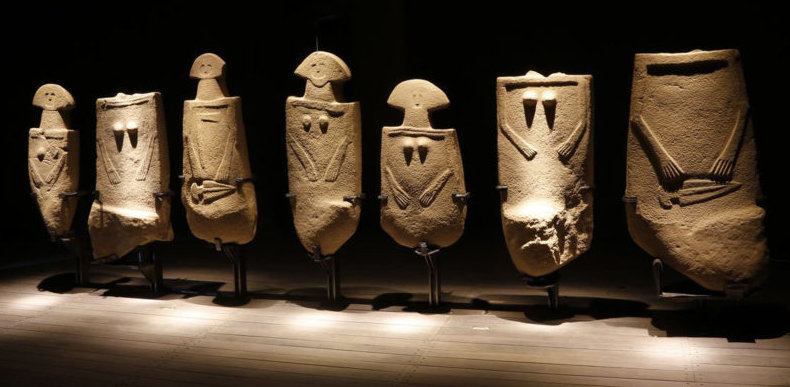
Lhe Lunigiana is a historical region located between northern Tuscany and eastern Liguria. In ancient times Lunigiana corresponded to the extension of the ancient Diocese of Luni, while today it corresponds to the river basin of the Magra River, administratively divided between the Provinces of Massa Carrara and La Spezia. Due to its geographical-morphological characteristics and its position, the Val di Magra has always been a land of passage and a natural corridor between different districts, of which evident contaminations are still visible today and which have strongly conditioned its historical events and the organization of its territory. The territory shows a strong characterization and cultural unity since prehistoric times, as evidenced still today by the famous “Lunigianesi Stele Statues,” preserved at the Piagnaro Castle in Pontremoli: these are anthropomorphic sculptures made of sandstone between the fourth and first millennia BC.
T he name of Lunigiana appeared in 1141 to refer to the territory that had been of the Roman municipality of the city of Luni and its diocese, which included 35 pievanies throughout the Magra valley with its tributaries, part of the Serchio valley, and the coastline including north of the Versilia river to Levanto. Today we refer to this territory as Historic Lunigiana. The city of Luni was founded at the mouth of the Magra River in the year 177 B.C. as a Roman colony following the defeat of the Apuan Ligurians. It had great importance in the imperial age thanks to the exploitation of the “Lunense” marble quarries (later known as Carrara marble) and the resources of inland Lunigiana. The port of Luni guaranteed the spread of these products throughout the empire. In addition, a road network crossed the territory as early as the Republican era. However, the Luni production and mercantile system entered a crisis from the 4th century onward, when the quarries were closed and the port, gradually silted up, was abandoned. Luni died as a city, and no center or political entity developed to the point of again giving administrative unity to the territory of Lunigiana
Lhe Lunigiana is a historical region located between northern Tuscany and eastern Liguria. In ancient times Lunigiana corresponded to the extension of the ancient Diocese of Luni, while today it corresponds to the river basin of the Magra River, administratively divided between the Provinces of Massa Carrara and La Spezia. Due to its geographical-morphological characteristics and its position, the Val di Magra has always been a land of passage and a natural corridor between different districts, of which evident contaminations are still visible today and which have strongly conditioned its historical events and the organization of its territory. The territory shows a strong characterization and cultural unity since prehistoric times, as evidenced still today by the famous “Lunigianesi Stele Statues,” preserved at the Piagnaro Castle in Pontremoli: these are anthropomorphic sculptures made of sandstone between the fourth and first millennia BC.
The name of Lunigiana appeared in 1141 to refer to the territory that had been of the Roman municipality of the city of Luni and its diocese, which included 35 pievanies throughout the Magra valley with its tributaries, a part of the Serchio valley, and the coastline including north of the Versilia river to Levanto. Today we refer to this territory as Historic Lunigiana. The city of Luni was founded at the mouth of the Magra River in the year 177 B.C. as a Roman colony following the defeat of the Apuan Ligurians. It had great importance in the imperial age thanks to the exploitation of the “Lunense” marble quarries (later known as Carrara marble) and the resources of inland Lunigiana. The port of Luni guaranteed the spread of these products throughout the empire. In addition, a road network crossed the territory as early as the Republican era. However, the Luni production and mercantile system entered a crisis from the 4th century onward, when the quarries were closed and the port, gradually silted up, was abandoned. Luni died as a city, and no center or political entity developed to the point of again giving administrative unity to the territory of Lunigiana
The Middle Ages
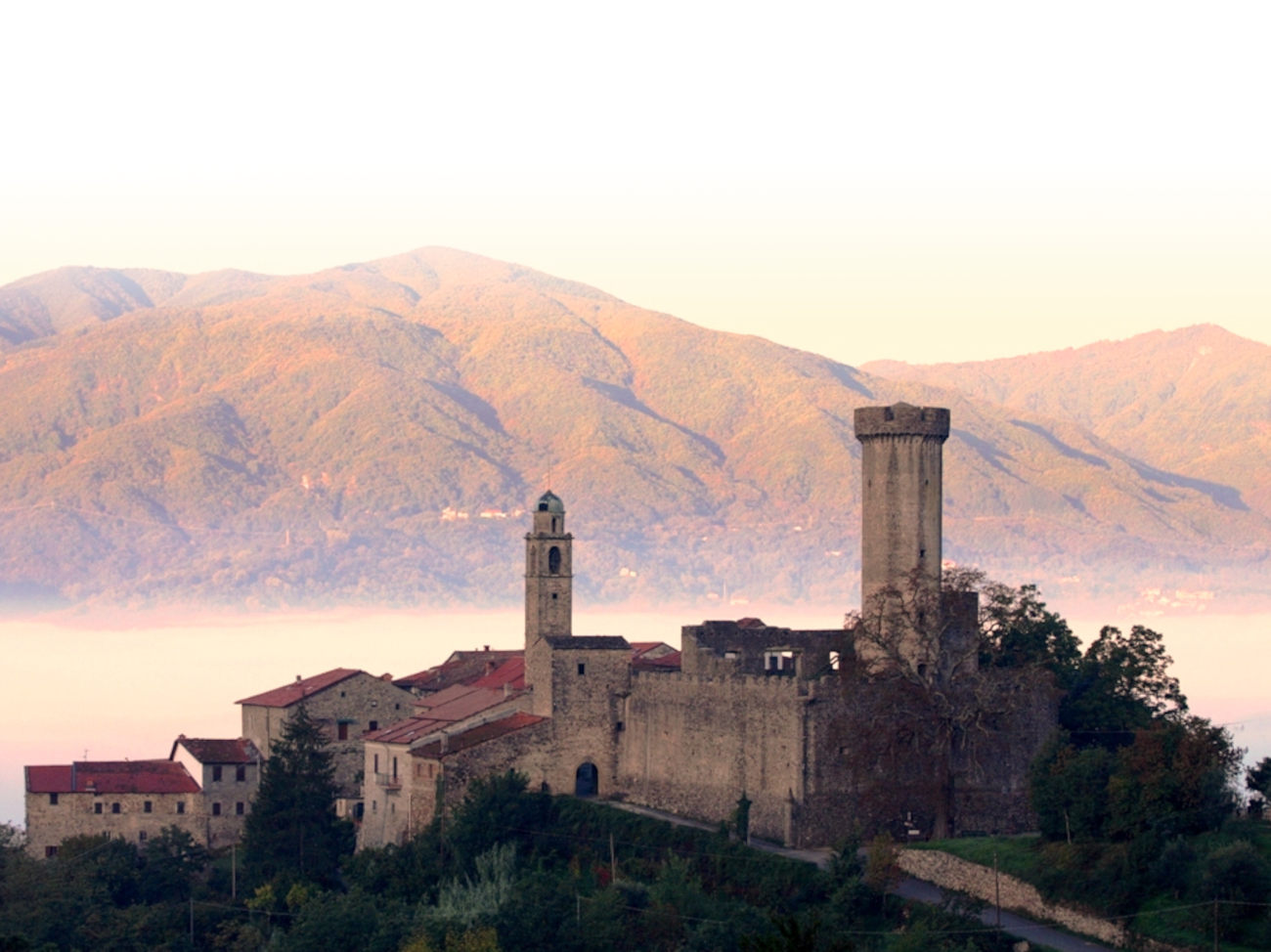
Dfter the end of the Western Roman Empire, during the period of barbarian invasions (6th-7th centuries), Lunigiana was the scene of clashes between Byzantines and Lombards, several castles were in fact built, for a kind of fortified line or “limes.”
After the final Lombard conquest of the territory, Lunigiana began to orbit the Lucca area. This influence continued even under the Franks: as the final crisis of Luni was witnessed, weakened by Saracen and Norman plundering, the Lombard Duchy was replaced by a Carolingian Marquisate, but there were no major political changes until the 10th century. The territory was reorganized according to the model of “curtes,” rural landed estates that would be the basis of the later feudalization and encastellation of the territory Owners of these courts were the main aristocratic groups, but also bishops and churches. Prominent among the aristocratic groups were the Obertenghi and their various branches.
A mid-10th century, King Berengar II of Italy created the March of Eastern Liguria (Obertenga), effectively detaching Lunigiana from the rule of Lucca. It was entrusted to the count of Luni Oberto, progenitor of the Obertenghi.
In the 10th-11th centuries, the crisis of the Italic Kingdom and the absence of urban centers of reference fostered a strong fragmentation that led to the development of numerous small territorial lordships dominated now by noble families, now by the bishop-counts of Luni who became for long periods the real point of reference.
The 12th and 13th centuries are still characterized by strong political instability in which, however, the rise of the Malaspina family (one of the four branches of the ancient Obertenghi) and the consolidation of the power of the Bishops of Luni emerge.
The 13th century was the period of maximum development of the expansive actions of the Malaspina, who increasingly came into friction with the bishops, counts of Luni. Their clashes ended only with the peace signed in the year 1304 at the castle of Castelnuovo di Magra, in which Dante Alighieri (in exile precisely in Lunigiana) participated as procurator of the Malaspina. The bishop retained only limited power in the littoral and lower Magra valley, while the entire central and northern sector remained in the hands of the Malaspina, who nevertheless never succeeded in forming a unified lordship. In fact, the Malaspina estate was divided into two large blocks: Corrado Malaspina, the first representative of the Spino Secco, was assigned all the territory located on the right bank of the Magra while Obizzo Malaspina, progenitor of the Spino Fiorito strain, was assigned all the territories laid out on the left bank of the Magra with the exception of Villafranca, based in Filattiera. Only Pontremoli, a free commune, did not follow the fortunes of the Malaspina dynasty.
Qhis first major division was followed by other irreversible subdivisions that led to an impressive fragmentation of the territory, which eventually led to Lunigiana being dominated by external lordships and powers from the late Middle Ages. After brief attempts to unify the territory by a few figures such as Castruccio Castracani and Spinetta Malaspina, in the first half of the 14th century, Lunigiana was divided among the major city-states of the time: Genoa, Milan, Lucca, and Florence.
Modern Age
Lhe Lunigiana in the modern age continued to be a frontier territory between different municipalities and seignories of different entities. Genoa, Florence and Milan gradually expanded their influence by taking control of different areas of the territory, interspersed with smaller and smaller marquisates in the hands of the Malaspina.
The years of the French Revolution and Napoleon also caused great changes in Lunigiana.
The areas historically divided into fiefdoms were incorporated first into the Cisalpine Republic and then into the Kingdom of Italy. Similarly, the areas of the Val di Magra governed by the Grand Duchy of Tuscany became part of the Kingdom of Etruria.
Cn the defeat of Napoleon and the Restoration, the Congress of Vienna (1814-15) sanctioned that the former imperial fiefdoms came under the rule of the Este family of Francis IV of Hapsburg, Duke of Modena and Reggio (from 1829 also Duke of Massa and Prince of Carrara) while the territories of Fivizzano, Pontremoli, Codiponte, Bagnone, Castiglione del Terziere, Casola and Caprigliola were assigned to the Grand Duchy of Tuscany.
The 1844 Treaty of Florence finally closed the Napoleonic period and delineated “Three Lunigiana“: a Lunigiana assigned to the Duchy of Parma and Piacenza, with Pontremoli and Bagnone; a Lunigiana assigned to the Duchy of Modena and Reggio with Fivizzano, Aulla, Licciana, Massa and Carrara; and a Lunigiana assigned to the Kingdom of Sardinia, with Sarzana, La Spezia and the Val di Vara.
Nn 1859, the year of the Second Italian War of Independence, the Lunigiana territory regained its unity and proclaimed its annexation to the Kingdom of Sardinia. With theunification of Italy (1861), Lunigiana became part of the province of Massa Carrara, with no respect for the region’s history and traditions. The dictator of Modena Luigi Carlo Farini split the territory of Historical Lunigiana in two, creating precisely the province of Massa Carrara with the Val di Magra and part of Garfagnana, while La Spezia and the Val di Vara were assigned to the province of Genoa.
At the end of the 19th century, socialist ideas also penetrated Lunigiana and the first nuclei of the labor movement began to form. Relevant in this regard were the Lunigiana uprisings, an insurrectionary agitation that began in Carrara in 1894 in protest against rising food prices and was harshly repressed with the proclamation of a state of siege throughout the Val di Magra territory.
Nn the first part of the 20th century, Lunigiana experienced one of its most difficult historical phases: in a territory already greatly affected by the phenomenon ofemigration to worsen the economic and social picture came the First World War and, in 1920, a terrible earthquake that struck the eastern area.
The Second World War made the situation even worse, since Lunigiana was the back of the Gothic Line, the demarcation line of the front that separated the territories still occupied by Nazi-Fascist forces and the territories liberated by the Allies . Because of its location, therefore, Lunigiana became one of the most important terrains of action for the partisan brigades.
Ttween 1943 and 1945 Lunigiana suffered some of the saddest and most heinous episodes of the entire conflict, commemorated throughout the territory by plaques and memorial stones. As a testimony to the importance and widespread diffusion of the Liberation Struggle in the Lunigiana territory, both the Provinces of Massa Carrara and La Spezia were decorated with the Gold Medal for Military Valor for the War of Liberation.
The Middle Ages
Dfter the end of the Western Roman Empire, during the period of barbarian invasions (6th-7th centuries), Lunigiana was the scene of clashes between Byzantines and Lombards, several castles were in fact built, for a kind of fortified line or “limes.”
After the final Lombard conquest of the territory, Lunigiana began to orbit the Lucca area. This influence continued even under the Franks: as the final crisis of Luni was witnessed, weakened by Saracen and Norman plundering, the Lombard Duchy was replaced by a Carolingian Marquisate, but there were no major political changes until the 10th century. The territory was reorganized according to the model of “curtes,” rural landed estates that would be the basis of the later feudalization and encastellation of the territory Owners of these courts were the main aristocratic groups, but also bishops and churches. Prominent among the aristocratic groups were the Obertenghi and their various branches.
A mid-10th century, King Berengar II of Italy created the March of Eastern Liguria (Obertenga), effectively detaching Lunigiana from the rule of Lucca. It was entrusted to the count of Luni Oberto, progenitor of the Obertenghi.
In the 10th-11th centuries, the crisis of the Italic Kingdom and the absence of urban centers of reference fostered a strong fragmentation that led to the development of numerous small territorial lordships dominated now by noble families, now by the bishop-counts of Luni who became for long periods the real point of reference.
The 12th and 13th centuries are still characterized by strong political instability in which, however, the rise of the Malaspina family (one of the four branches of the ancient Obertenghi) and the consolidation of the power of the Bishops of Luni emerge.
The 13th century was the period of maximum development of the expansive actions of the Malaspina, who increasingly came into friction with the bishops, counts of Luni. Their clashes ended only with the peace signed in the year 1304 at the castle of Castelnuovo di Magra, in which Dante Alighieri (in exile precisely in Lunigiana) participated as procurator of the Malaspina. The bishop retained only limited power in the littoral and lower Magra valley, while the entire central and northern sector remained in the hands of the Malaspina, who nevertheless never succeeded in forming a unified lordship. In fact, the Malaspina estate was divided into two large blocks: Corrado Malaspina, the first representative of the Spino Secco, was assigned all the territory located on the right bank of the Magra while Obizzo Malaspina, progenitor of the Spino Fiorito strain, was assigned all the territories laid out on the left bank of the Magra with the exception of Villafranca, based in Filattiera. Only Pontremoli, a free commune, did not follow the fortunes of the Malaspina dynasty.
Qhis first major division was followed by other irreversible subdivisions that led to an impressive fragmentation of the territory, which eventually led to Lunigiana being dominated by external lordships and powers from the late Middle Ages. After brief attempts to unify the territory by a few figures such as Castruccio Castracani and Spinetta Malaspina, in the first half of the 14th century, Lunigiana was divided among the major city-states of the time: Genoa, Milan, Lucca, and Florence.
Modern Age
Lhe Lunigiana in the modern age continued to be a frontier territory between different municipalities and seignories of different entities. Genoa, Florence and Milan gradually expanded their influence by taking control of different areas of the territory, interspersed with smaller and smaller marquisates in the hands of the Malaspina.
The years of the French Revolution and Napoleon also caused great changes in Lunigiana.
The areas historically divided into fiefdoms were incorporated first into the Cisalpine Republic and then into the Kingdom of Italy. Similarly, the areas of the Val di Magra governed by the Grand Duchy of Tuscany became part of the Kingdom of Etruria.
Cn the defeat of Napoleon and the Restoration, the Congress of Vienna (1814-15) sanctioned that the former imperial fiefdoms came under the rule of the Este family of Francis IV of Hapsburg, Duke of Modena and Reggio (from 1829 also Duke of Massa and Prince of Carrara) while the territories of Fivizzano, Pontremoli, Codiponte, Bagnone, Castiglione del Terziere, Casola and Caprigliola were assigned to the Grand Duchy of Tuscany.
The 1844 Treaty of Florence finally closed the Napoleonic period and delineated “Three Lunigiana“: a Lunigiana assigned to the Duchy of Parma and Piacenza, with Pontremoli and Bagnone; a Lunigiana assigned to the Duchy of Modena and Reggio with Fivizzano, Aulla, Licciana, Massa and Carrara; and a Lunigiana assigned to the Kingdom of Sardinia, with Sarzana, La Spezia and the Val di Vara.
Nn 1859, the year of the Second Italian War of Independence, the Lunigiana territory regained its unity and proclaimed its annexation to the Kingdom of Sardinia. With theunification of Italy (1861), Lunigiana became part of the province of Massa Carrara, with no respect for the region’s history and traditions. The dictator of Modena Luigi Carlo Farini split the territory of Historical Lunigiana in two, creating precisely the province of Massa Carrara with the Val di Magra and part of Garfagnana, while La Spezia and the Val di Vara were assigned to the province of Genoa.
At the end of the 19th century, socialist ideas also penetrated Lunigiana and the first nuclei of the labor movement began to form. Relevant in this regard were the Lunigiana uprisings, an insurrectionary agitation that began in Carrara in 1894 in protest against rising food prices and was harshly repressed with the proclamation of a state of siege throughout the Val di Magra territory.
Nn the first part of the 20th century, Lunigiana experienced one of its most difficult historical phases: in a territory already greatly affected by the phenomenon ofemigration to worsen the economic and social picture came the First World War and, in 1920, a terrible earthquake that struck the eastern area.
The Second World War made the situation even worse, since Lunigiana was the back of the Gothic Line, the demarcation line of the front that separated the territories still occupied by Nazi-Fascist forces and the territories liberated by the Allies . Because of its location, therefore, Lunigiana became one of the most important terrains of action for the partisan brigades.
Ttween 1943 and 1945 Lunigiana suffered some of the saddest and most heinous episodes of the entire conflict, commemorated throughout the territory by plaques and memorial stones. As a testimony to the importance and widespread diffusion of the Liberation Struggle in the Lunigiana territory, both the Provinces of Massa Carrara and La Spezia were decorated with the Gold Medal for Military Valor for the War of Liberation.