

Pieve di Codiponte – Casola in L.na
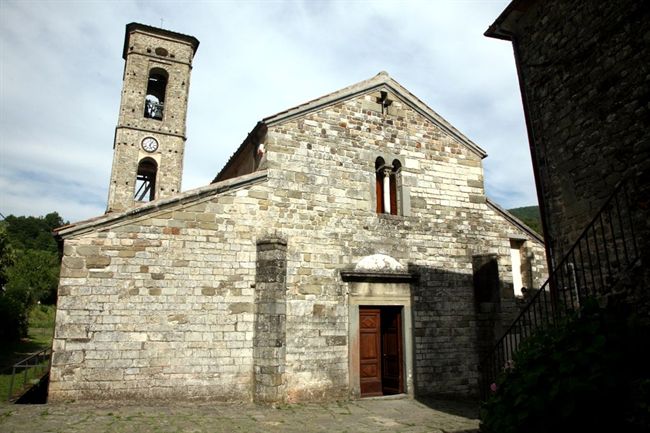
The parish church of Codiponte, in the municipality of Casola in Lunigiana, is among the most fascinating and artistically rich in the territory of the ancient Diocese of Luni; with its figured capitals, its austere and balanced form, and its artistic masterpieces, it is a true paradigm of Lunigiana Romanesque architecture. The pieve stands on the right bank of the Aulella, near a bridge beyond which the ruins of the 11th-century castle of the Bianchi d'Erberia can be seen in the distance. We are in an area rich in prehistoric finds and stele statues, a strategic area of passage as the place name also testifies. Along this road axis the Romans connected Luni with Lucca and, further north, with Veleia and Piacenza.
While excavations in the area have revealed on the same site where the pieve stands today traces of Ligurian (7th S. B.C.) and Roman frequentation, the earliest documentary mention is pre-Carolingian (793); this historical phase is evidenced by the octagonal baptismal font base from the 8th century, which shows that the church was already baptismal before it became a pieve.
Mentioned several times in the twelfth and thirteenth centuries, in the late Middle Ages and in the post-medieval and modern ages the pieve played a central function in the religious organization of the upper Aulella valley. Mentioned in the Decimes of the late 13th century and in the Estimi of 1470-71 it extended its cope from Vinca to Spicciano in the Lucido, Aulella and Rosaro valleys.
The church has a three-aisle basilica plan with perfectly preserved columns and round arches and notched cubic capitals bearing figures typical of the medieval image system. Symbolic images with didactic, didactic, and theological significance that unfold a rich repertoire: palmettes, tree of life, lily, six-petaled daisy; telamon, praying man, man blowing two horns, rampant beasts, camel, birds, snake with feet, bicauded siren.
The roof is trussed, redecorated in the 1900s; a monolithic medieval baptismal font with a cross and figures of children in swaddling clothes carved in bas-relief on the base are visible in the south aisle. Also on the south side, outside, is a beautiful portal with medieval symbols, probably the original portal of the parish, later disassembled and reassembled in a different position.
Also of interest is the late medieval triptych with the Virgin Enthroned, Sts. Cornelius and Cyprian titulars of the church, and the image of the Holy Face, a famous and revered Lucchese relic, which reminds us of the passage, in these very places, of the Way of the Holy Face.
The church, remodeled and decorated from the 1500s onward, was restored to bare stone in the late 1800s and restored again in the early 1970s when archaeological tests were also conducted, giving us the most information about the site. At this stage the minor apse was completely reconstructed.
The bell tower, once to the left of the chancel (where the base remains), was rebuilt in 1778.
(From Francesco Bola: Tourism in Lunigiana https://turismoinlunigiana.it/scheda/pieve-di-codiponte/)