

Pieve di Sorano – Filattiera
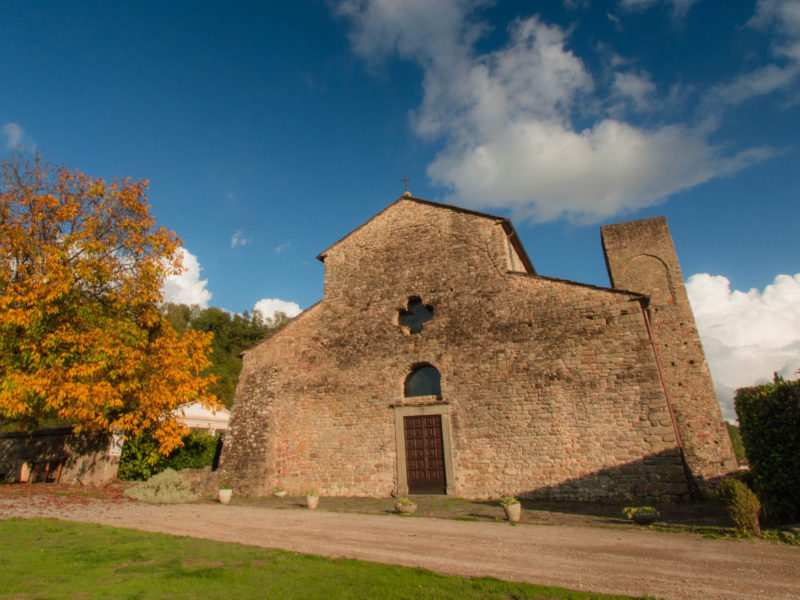
The parish church of Santo Stefano di Sorano in Filattiera is one of the most important Romanesque parish churches in the province of Massa Carrara. It stands in a strategic area, frequented since prehistoric times (as many as seven stele statues have been found in the area) and still preserves its 12th-century layout, a Romanesque architectural masterpiece, with an imposing apsidal system made entirely of unhewn sandstone pebbles. Inside the parish church, which has been fully restored, numerous medieval elements are preserved as well as two original stele statues (Soran I and Soran V).
The area where the pieve stands has been frequented since prehistoric times, as evidenced by the 7 stele statues found in the surrounding area and numerous Iron Age finds. After the Roman phase, evidenced by the presence of a recently archaeologically investigated "mansio," Filattiera was an important Byzantine military settlement, Before the present parish church there must have been another early medieval church (8th-9th century) from which the Epigraph of Leodegar (752 AD.C.) today in the church of San Giorgio within the village.
The Romanesque parish church was built between the 11th and 12th centuries as part of the ecclesiasitic reorganization of the Diocese of Luni, of which this church represents perhaps the most important dependency in Lunigiana. The parish church of S. Stefano di Sorano is mentioned from the 11th century onward in all the main documents related to the Diocese of Luni and experienced its heyday until the 14th century, when it began to be abandoned and was gradually transformed into a cemetery chapel.
The present appearance is the result of an extensive restoration completed in 2000, which restored the original appearance. The entire building is built with a very special technique, with unsquared river pebbles put in place with abundant mortar.
The plan is basilical with three naves, without a transept, with the nave larger than the other two and the chancel slightly elevated. On the façade can be seen the polylobate Rosette and some openings plugged in the masonry. On the left inner counterfaçade, in the corner, are the stele statues Soranus I and Soranus V, found in the area of the church: the Soranus V was reused as the lintel of a small entrance opened in the façade and later plugged.
The interior is sober, severe, dimly lit, with large double-arched arches resting on round pillars with very short incised capitals. A few eighteenth-century masonry arches inserted between Romanesque ones remain on the left side.
The decoration and symbolism are kept to a minimum, however, there are some interesting images, particularly the monstrous figure present in the upper part of the nave on the left side.
The most architecturally interesting part of the parish from the point are certainly the three apses, made with architectural decoration on different levels of depth. In the upper part of the major apse, traces of some small figured half-capitals can be seen.
The bell tower, perhaps born as a defensive structure, is connected to the church but represents a separate element.
A few meters from the parish church, heading north, now stands the Sorano Educational Center, home to an area equipped for excavation exercises, educational lectures on archaeology, conferences and conventions.
(From Francesco Bola: Tourism in Lunigiana https://turismoinlunigiana.it/scheda/pieve-di-sorano/)