
Malaspina Castle of Massa

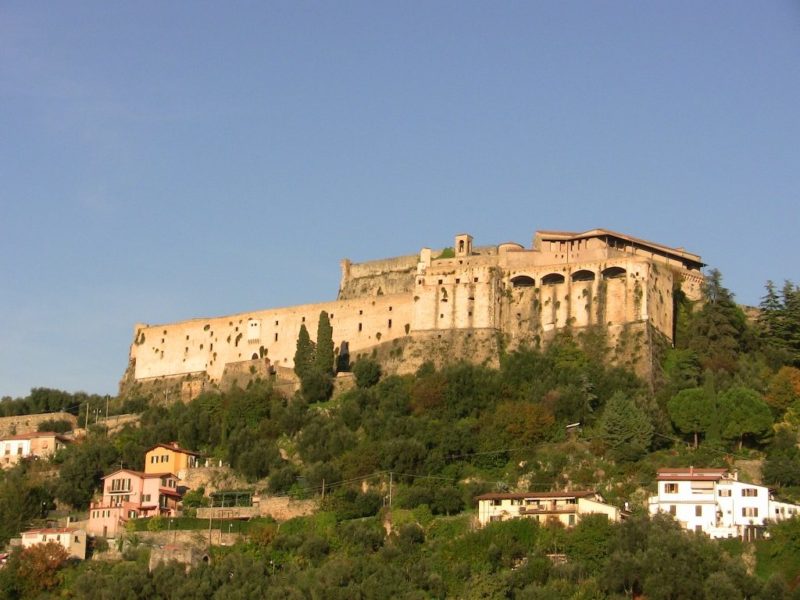
The Castle of Massa dominates from the top of a rocky hill the extensive flat area below, with wide visibility of the entire coast. It was in all likelihood these features that determined the occupation of the hill where, presumably in the early Middle Ages, a fortified facility was built.
Written documentation mentions the toponym Massa in 882; according to historians, the locality must have been situated on the hill of the castle
The castle, seat of the marquises of Massa, had special relations with the coast and the sea. These marquises, fighting pirates, made themselves feudal lords of Corsica as well, assuming the predicate: marquises of Massa-Corsica. The first written documentation concerning the castle dates back to 1164, when Emperor Frederick Barbarossa assigned part of the castle to Obizzo Malaspina. Some chroniclers recall that Massa, about a century later, in 1268, suffered occupation by the troops of Corradino di Svevia who devastated the territory. The following year the castle was destroyed by the Lucchese, who did not tolerate the willingness offered by the people of Massa to the emperor's troops.
The historical and architectural vicissitudes of the castle for the first centuries of the late Middle Ages remain in obscurity; ousted by the Marquis of Massa, the Malaspina family took over entirely, ceding the castle in the early 14th century to Castruccio Castracani degli Antelminelli. From the 14th century to the middle of the following century Massa and its castle depended on Lucca, Pisa, and Florence, later becoming the property of the Marquis Malaspina of Fosdinovo. It was with this seigniory that the castle took on the role of residence and underwent the most profound transformations, in a period between 1400 and 1600.
After the mid-17th century the main function of the castle became military until, the pre-unification states having waned, it remained as its only use as a prison, which continued until 1946. Restorations carried out by the Soprintendenza ai Monumenti di Pisa in the 1950s returned the castle to the city.